From WordPress to AI-Press: After Seven Years of Running Websites, AI Agents Changed Everything in Five Days
In 2019, I started learning WordPress
I started learning WordPress (WP for short) in 2019.
Back then, building a website meant hunting through Google results for needles in a haystack and piecing together whatever I could find until I had a site that actually worked.
Over the next seven years of building and maintaining WP sites, I went through an enormous amount of tedious work.
At first, I didn’t know how to use Redis caching, and editing the site was painfully slow. Logging into the WP dashboard in a browser to edit articles was an ordeal. I’d often get so drowsy while working that I could barely stay awake.
Later, I did use VB.NET and Python to build some automation tools through the WordPress REST API, reducing the manual workload.
But all that really did was change my tedious job from editing articles to writing automation code.
I even had to adjust the settings for the IIS (Internet Information Services) web server myself. Whenever something went wrong with a site, I’d have to spend time figuring out how to fix it.
Looking back, how much time did I spend on all this busywork over those seven years?
AI content churn and the pressure on small online publishers
I’d already noticed AI’s potential for churning out rehashed content before GPT-4 launched in 2023.
Later, more and more people started using AI to mass-produce content, filling the internet with garbage. Google kept updating its search rules to try to deal with this low-quality material.
But to me, Google’s search results increasingly seemed to favor content from big domains.
Small online publishers like me faced brutal pressure just to survive.
I had to keep adding new content and find ways to make up for the shortfall in Google AdSense revenue.
It felt like being a hamster running flat out on a wheel: working hard all the time, but going nowhere.
I spent huge amounts of time maintaining my sites and adding content, yet I struggled to get beyond my previous revenue peak.
To make matters worse, Google increasingly provides AI-generated answers directly in its search results.
People may get everything they need from Google’s AI summaries without ever clicking through to a website.
I’ve seen reports from overseas discussing the impact of Google’s AI search on content sites, along with questions about content licensing and revenue sharing.
I’m fairly pessimistic about all this.
I think Google will prioritize deals with major media companies that have the resources to sue it. Small publishers probably won’t see much of the money.
Google is becoming ever more greedy and shameless as it sucks the lifeblood out of websites.
The irony is that the AdSense revenue many of us site owners earn comes from Google in the first place.
But I no longer want chasing Google rankings to be the sole focus of running my sites.
I’m now running different experiments to maximize advertising revenue.
If traffic falls but ad revenue rises, I can live with that.
Conversely, if an optimization increases traffic without doing much for revenue, I’m not inclined to pursue it.
I don’t think search engine optimization (SEO) has lost all its value, either. Bing, for example, is still a search engine I think we absolutely need to pay attention to.
Sometimes, improving a headline may be the most cost-effective optimization of all.
Google Search Console provides information about search impressions, clicks, and user queries, helping me decide which articles could benefit from a better headline. Even those edits can now be handled automatically by an AI agent.
But more than continuing to chase Google’s algorithm, I want to use the productivity AI agents bring to open up new opportunities.
The times have changed—and it happened almost overnight
Even now, I still see WordPress AI plugins advertising that they can bring ChatGPT or Claude into the WP dashboard through APIs from companies such as OpenAI and Anthropic.
They promise AI-assisted article generation, writing help, and even automatic publishing.
But I have to say: there’s now absolutely no need to do it that way.
The times have changed. And it happened almost overnight.
It reminds me of the early 1990s.
We were using modems to dial up to the internet, data transfer was painfully slow, and file compression mattered a great deal.
There were lots of BBSs (Bulletin Board Systems) overseas. People connected to them by modem to exchange files and download shareware.
The hugely popular game Wolfenstein 3D, for instance, spread through channels like these.
In those days, a more powerful compression tool could quickly change the habits of an entire BBS community.
The once-popular ARC format, for example, was gradually displaced by the ZIP format used by PKZIP. LZH and ARJ were also very popular for a time.
I remember the feeling: almost overnight, the compression formats on BBSs seemed to be undergoing a complete reshuffle. Tools everyone had been used to were quickly replaced by new ones.
Of course, those formats didn’t all disappear on the same day. But for those of us who lived through that period, the sense of a technological changing of the guard was unmistakable.
Now, in 2026, I’m feeling that again.
This time, though, it’s not just file compression tools that are changing. It’s the entire way we operate computers, develop software, and run websites.
On October 3, 2026, the way I ran WordPress changed overnight
Just five days ago, on October 3, 2026, I began using the entire WordPress site directory as Codex’s project working directory.
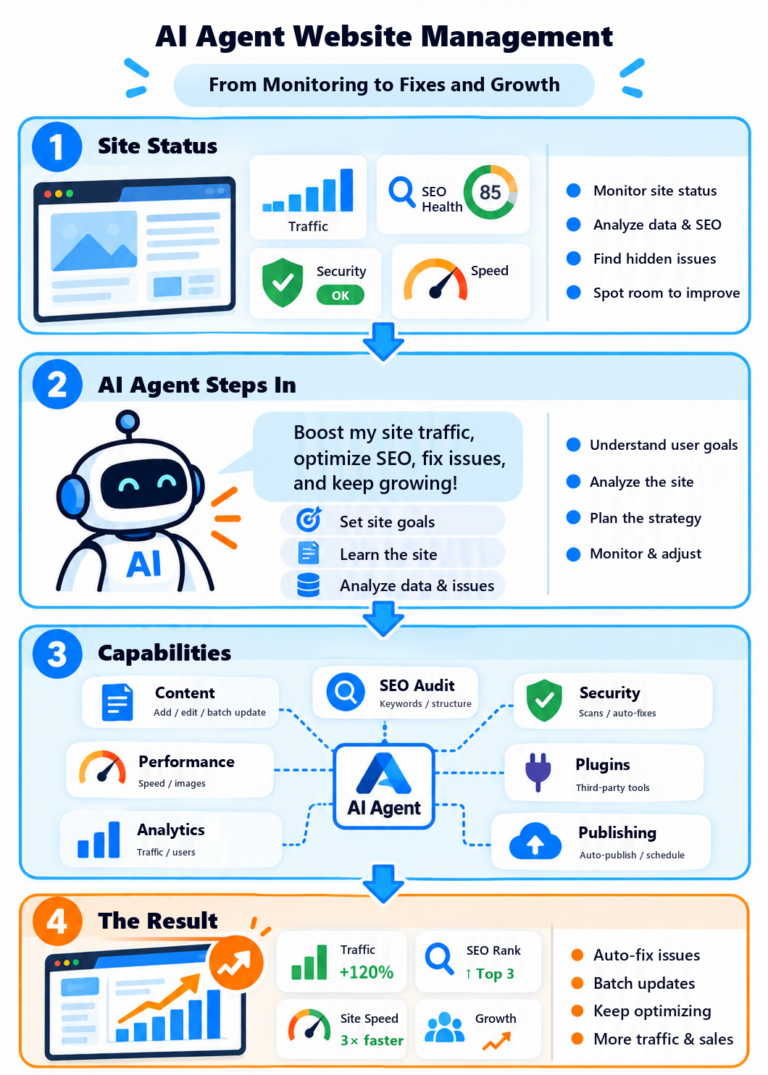
I gave it a little guidance, and it began managing my site automatically.
In the past, whenever I needed a feature, I first had to look for a suitable WordPress plugin and work out which one was best. Some features even required payment.
But now, I don’t need any of that anymore!
Codex and Claude Code can handle it for me.
Whatever feature I need, I can simply tell an AI agent. It can write the code in WordPress and build exactly what I want.
Then the plugin the AI agent developed appears in the WordPress dashboard.
I don’t even have to write the code myself.
For example, I first had ChatGPT in the browser plan a comment moderation and spam filtering system for this site, then handed the plan to an AI agent to implement.
Later, I realized that WordPress’s default comment system doesn’t let ordinary users upload images directly with their comments.
So I told Codex:
"Can you make the comment system let users upload images? Limit it to one image at a time, allow only common image formats, and set a reasonable file size limit. Help me plan it."
An AI agent rarely tells me, "That can’t be done."
Usually, it says, "Sure."
Then it plans the work, gets started, and a few minutes later, my site has the feature.
This is how running a WordPress site has changed in this era.
In just a few days, I’ve added all sorts of custom features to my site.
And I’m quite certain that no ready-made WordPress plugin could meet my needs perfectly.
It goes beyond adding features, too.
I even had Codex and Claude Code work together to make the site multilingual.
I didn’t use a traditional WordPress multilingual plugin. I had AI agents plan, develop, and manage the system themselves.
Now, when I want to change how a page looks, I don’t have to study the theme settings myself.
I just take a screenshot and tell Codex what needs changing.
Sometimes I simply say, "The colors are ugly."
That’s the sort of thing a demanding client would say.
But the AI doesn’t complain. It gets straight to work changing them for me.
It also created a WordPress child theme for me, knows how to read the MySQL database, and can retrieve site content directly from it.
These days, I barely need to log into the WordPress dashboard at all.
I can give instructions in the AI agent’s chat window, and it takes care of the site.
Those plugins that advertise "type a prompt in the WordPress dashboard and generate an AI article" now look outdated.
I don’t even want to open the WordPress dashboard. Why would I need to install an AI writing plugin inside it?
Website maintenance that took months now gets done in a day
The change AI agents bring is even more striking for sites that have been running for years.
In the past, I used SEO analysis tools such as Ahrefs.
Yes, the reports were detailed.
They could list the errors on my site, the broken links, and the areas that needed optimization.
But I still had to make the changes manually.
Now I can leave the whole job to an AI agent.
All I need to do is give it a task: check the site’s health, fix errors, improve SEO, and optimize support for AI search engines and AI crawlers.
Then it gets to work.
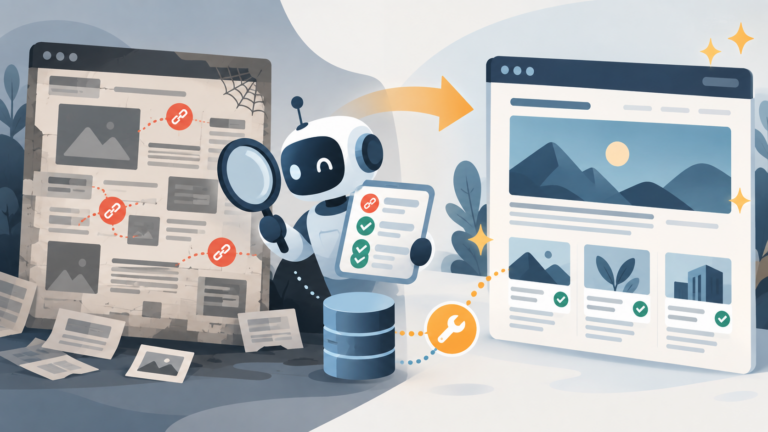
For example, I recently had Codex give some old sites a health check and a facelift.
It backed them up first, checked for outdated content and links returning HTTP 404 errors, and then fixed the problems one by one.
When information needed updating, it looked up the latest facts online, verified them, and only then made changes.
I also set rules requiring backups before changes and preserving verification reports and records of every repair.
If I don’t like the result, I can ask it to restore the previous version.
So I’m not worried about it breaking my site.
If it breaks something, just restore it.
In the past, fixing years of accumulated problems could take months, and the quality still wasn’t necessarily good.
Now, a visual facelift, error repairs, and content corrections can often be completed within a day.
The efficiency is astonishing.
I’ve also noticed that on some sites, Google AdSense revenue per thousand impressions (RPM) rose noticeably in the short term after Codex made changes.
Of course, that needs more observation. I can’t be sure the AI agent’s changes caused it; it may just be short-term fluctuation.
But it makes me want to apply the same optimization approach to other old sites.
To me, that’s the real change.
The SEO tools of the past told you where the problems were. Now an AI agent can fix them for you directly.
If you wanted, you could even have an AI agent build an Ahrefs-style tool specifically for your own domain.
The AI model determines everything—don’t save money in the wrong place
There’s one point I really have to emphasize.
The AI model determines everything.
As of October 2026, I think OpenAI’s GPT-6.1 Sol (Medium) and Anthropic’s Claude Opus 5.5 (Medium) offer the best balance of cost and usefulness.
For ordinary people, these are affordable AI models that can actually get things done.
Some people may be determined to deploy an open-source large language model (LLM), such as Qwen, on their own computer.
I think that’s a complete waste of time.
Out of curiosity, I even looked up some technical bloggers who had previously received Microsoft’s Most Valuable Professional (MVP) award, to see how they’re using AI now.
I found some were still using AI code completion inside an integrated development environment (IDE), or deploying an LLM locally and then complaining that it ran slowly and hallucinated.
But we’ve long since moved beyond having AI fill in a few lines of code.
You can hand an entire project to an AI agent and let it read the code, plan, develop, run, test, and fix errors on its own.
Tasks you once had to sit down at a computer and carry out yourself can now be delegated directly to an AI agent.
For just US$20 a month, your productivity can take off overnight.
For example, ChatGPT Plus and Claude Pro both have a base monthly price of US$20 in the United States.
Subscribe to both, and the total is only around US$40 a month. Of course, usage limits and which models you can actually use still depend on each plan.
For me, that money is incredibly well spent.
It’s like hiring several employees with superpowers.
I know some people worry about depending on large cloud AI companies, or insist on hosting a model at home.
But that’s not how I see it.
I want to embrace the most advanced commercial AI models and tools.
Only then do AI agents show what they’re truly capable of.
If saving US$20 a month means spending huge amounts of time figuring out local model deployment and putting up with limited capabilities and slow performance, I’d rather just pay OpenAI and Anthropic.
I want productivity. I don’t want to sacrifice productivity just to save money.
Is SaaS finished? To a large extent, I think it is
Some people say SaaS (Software as a Service) is finished.
To a large extent, I think they’re right.
Here’s an example.
In the past, we might have needed Adobe Photoshop to cut objects out of images or fill in missing areas.
Now I’ve used the open-source tool IOPaint, together with AI models such as Stable Diffusion XL (SDXL) and LaMa, to build an image editing tool that runs in a browser.
For the cutout and inpainting features I need, it’s practically a free alternative on par with Photoshop.
Finally, I don’t have to wrestle with Adobe’s annual subscription policies anymore. What a relief.
And the tool is built entirely around my needs.
If I need a feature, I ask an AI agent to add it. If I don’t need it, I remove it.
I don’t need the whole of Photoshop.
I just need a tool that gets my work done.
In the past, this was custom software development with a very high price tag.
Now an AI agent can find suitable open-source options, combine and modify them to suit my needs, and build software specifically to solve that problem.
And I can add new features whenever I want.
The same goes for WordPress sites.
In the past, if I needed a feature, I had to hunt down a plugin and sometimes pay for a subscription.
Now I just have an AI agent develop it.
This change in the cost structure is going to have a huge impact on many software service businesses.
Of course, that doesn’t mean every SaaS product will disappear.
But for software that provides just a few specific features and charges a recurring subscription, I think the years ahead could be very difficult.
Traditional website management agencies face a major shock, too
Many people entrust their WordPress sites to an agency.
Then they find the site’s features are restricted and they have no real control.
Want to add a feature? You’re at the agency’s mercy.
Sometimes, even a small change means talking it through, waiting for a quote, and getting it scheduled.
Now Codex and Claude Code can handle it.
I can even imagine a future where a blogger who wants a WordPress site simply rents an inexpensive Linux cloud virtual private server (VPS) that meets the basic requirements, then installs Claude Code.
Then they tell it:
"I want to set up a WordPress site. Find suitable skills, plan the installation and configuration, then build the site and put it live."
The AI agent can start planning, install the necessary software environment, create the database, configure the web server, and deploy WordPress.
Don’t like something?
Tell it to change it.
Need a new feature?
Tell it to build it.
Something goes wrong with the site?
Ask it to investigate and fix it.
And the AI doesn’t refuse to work just because it’s the weekend.
As long as the model has usage capacity left and the task conditions allow it, it can keep going.
How much of an advantage does a traditional website management agency still have in that world?
The point of working this way is that everyone can control their own website, rather than remain at the mercy of a management provider forever.
WordPress’s value may have changed
WordPress is a very mature website platform.
But I think its value may now have changed.
WordPress may now be simply a mature architecture that AI agents can learn from and put to use.
After all these years of development, WordPress has a very complete architecture for managing websites.
AI agents can use that existing foundation to reduce development time. They don’t have to start everything from scratch, and they can avoid a lot of unnecessary detours.
But that doesn’t mean users still need to be constrained by WordPress’s original features, themes, or plugins.
We can now direct AI agents to take this mature architecture and freely develop our sites into whatever we want them to be.
Want a feature? Have an AI agent develop it.
Does the original design fall short? Change it directly.
Features you don’t need can all be removed, too.
And all of this can be done very efficiently, at very low cost.
In the past, we had to spend a lot of time learning WordPress and adapting to the way it worked.
Now we can finally turn that around and make WordPress adapt to our needs.
From WordPress to AI-Press: letting website architecture evolve
I call this new way of building websites AI-Press.
It doesn’t mean installing an AI plugin in the WordPress dashboard.
It means letting AI agents use WordPress’s mature architecture as a foundation, then develop, modify, and maintain it according to the user’s needs—even keep refining it into new versions of the site.
Through repeated cycles of iteration, AI agents can improve the code, fix problems, and add features, evolving new versions at extraordinary speed.
That means we don’t have to go through a tedious installation, configuration, modification, and testing process every time we build a new site.
Once we’ve built an AI-Press website framework that fully meets our needs, copying it, changing it, and extending it into other sites takes only a prompt or two.
And the architecture can keep evolving.
If a feature isn’t good enough today, give it to an AI agent to improve.
If you think of a new feature tomorrow, have it add that.
The code, functional modules, and implementation experience accumulated along the way can all become the foundation for the next version.
In the past, this level of customization might have required an entire software development team.
Now, one person has a chance to do it.
A website is no longer software you install and then struggle to adapt to. It’s a system that can keep evolving with your individual needs.
Perhaps the WordPress team should consider dismantling the entire WordPress architecture and rebuilding it as a website architecture kit that AI agents can quickly understand and freely assemble.
Then WordPress would offer more than a ready-made website system. It would provide infrastructure that AI agents could efficiently combine, modify, and extend.
That’s the AI-Press I imagine.
AI agents have renewed my sense of the huge potential of online business
After discovering the extraordinary productivity of AI agents, I feel that online business has even greater potential.
I’d already been planning to expand the successful approach I’d used for content sites into other markets.
One overseas content site, which has only been operating for a few months, is already generating annualized revenue of about US$7,500 (NT$240,000).
That’s just one site.
If the same approach could be successfully replicated across ten sites at the same revenue level, that would be about US$75,000 (NT$2,400,000) a year.
Of course, that depends on each site successfully replicating those returns. It’s not a guaranteed result.
But with AI agents helping, the tasks that used to take the most time—organizing information, building websites, publishing content, and maintaining and updating sites—could all become much more automated.
Ideally, AI agents would keep updating information and fixing problems on the sites, while I focused on the business direction and checked the results.
That would let me pursue more different businesses at the same time.
Game development, for example.
I can now have AI agents maintain old sites while I plan new ones and keep making games.
In the past, that kind of productivity was unimaginable for one person.
Now I can even give them their tasks and go take a nap.
Everyone has been given the power to create with technology
Boris Cherny, the creator of Claude Code, made a point in an interview that really stayed with me.
He believes that over the next year or two, learning traditional programming could become much less important, because in many situations, programming no longer needs to be done by people themselves.
In the future, everyone will have a chance to create their own software.
And much of today’s world runs on information technology.
What does that mean?
It means every one of us has been given the power to create with technology.
In the past, if you wanted to develop software, build a website, or realize an idea involving information technology, you had to learn to code or pay someone who could.
Now that barrier is rapidly disappearing.
Here’s the metaphor I’d use.
In the past, we could only get around on foot. Now everyone has a voice-controlled helicopter.
Just say where you want to go.
A destination that once meant crossing mountains and taking days to reach is now somewhere you can fly to simply by naming it.
And you don’t have to learn how to build a helicopter first, or study the principles behind engines, transmission systems, and flight controls.
You just need to know where you want to go.
That’s the strongest feeling I get from using AI agents now.
Suddenly, ideas that once had to stay in my head because of technical barriers, development costs, or a lack of time are starting to become possible.
What excites me most is that this ability is no longer reserved for a small number of software engineers.
Everyone is starting to gain the ability to turn the ideas in their heads into software that actually works.
AI euphoria—and looking like a bunch of weirdos
I completely understand why people who use AI agents can’t stop.
It’s like being a king directing a group of capable advisers, and they almost never say "No."
So you become a conductor in a state of AI euphoria.
All at once, the ideas in your head become things you can actually build.
To everyone else, those of us caught up in AI euphoria probably look like a bunch of weirdos.
But I believe anyone who experiences the astonishing productivity of AI agents for themselves will wake up to it immediately.